My story
How I ended up in medical Latin, and why I still love teaching it.
Today’s students inspire me. Many of them know at school what they want to become. At 17 or 18 I had no idea. I went to university with a friend: she chose Polish, I chose classical philology. That’s where my story with Latin began.
My first year was hard but fascinating. I didn’t want to fall behind, so I studied non-stop. So much that, according to my roommate, I even spoke Latin in my sleep. Our teachers made us fall in love with the language and the grandeur of the Roman Empire, and I wanted to make it my profession.
We read Cicero, Caesar and Virgil, and studied dialects, the history of the language and the culture of Rome. I was fascinated by why a word is called what it is, which parts it is built from and what each part means. What drew me most was the grammatical and structural-semantic side of language: word formation and the etymology of words and terms. That curiosity led me to research and a monograph on terminology.
I have worked with Latin in many fields: with biotechnologists (Igor Sikorsky Kyiv Polytechnic Institute), lawyers, historians (Taras Shevchenko National University of Kyiv), and with medical, dental and pharmacy students (Bogomolets National Medical University). Medicine is what I came to love most. Medical students quickly see why they need Latin: it underlies medical terminology and helps them understand the professional language of medicine in any country.
At Bogomolets University I taught students of every speciality and mode of study: medicine, dentistry, pharmacy, international students and pupils of the Ukrainian Medical Lyceum. I watched future doctors, researchers and clinic owners grow. And again and again I saw the same picture: a huge amount of new material in very little time.
That’s when I realised I wanted not just to teach Latin but to make studying easier. What inspires me most is the moment after an explanation when a student’s face says: “Ahh… now I get it!”
There was a period when I went on two consecutive maternity leaves. Afterwards I chose my family and myself, and stepped away from teaching for a while. But my children grew up, and I realised I wanted to do what I love. That’s how my Latin blog began, and now I help students online.
Perhaps one of my students will one day discover a new medicine or develop a treatment protocol that helps thousands of people. And I’ll know I was a small part of their professional path. That’s why I still love teaching Latin.
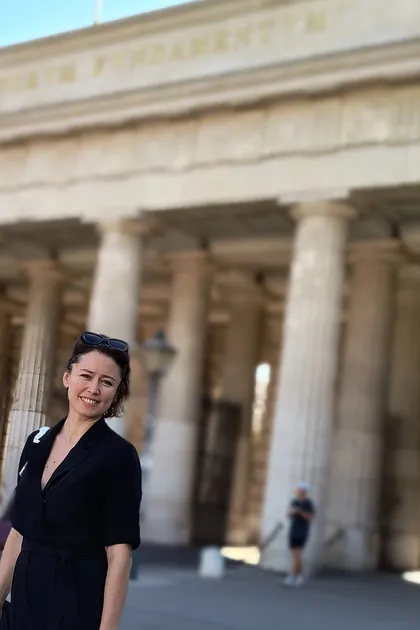
In brief
- 2003–2008
- Classical philology at university, with Latin as one of the core languages.
- 2007
- Began teaching Latin at Bogomolets National Medical University.
- 2009
- A conscious decision to stay in medicine.
- 2011
- Examiner at Bogomolets University.
- 2012–2013
- Dissertation and monograph on the structural-semantic aspect of Latin entomological nomenclature.
- to 2024
- 17 years at Bogomolets University, including work in the dean’s office for international students.
- 2024
- Moved to Czechia with my family. Teaching online on Zoom and Telegram.
Qualifications
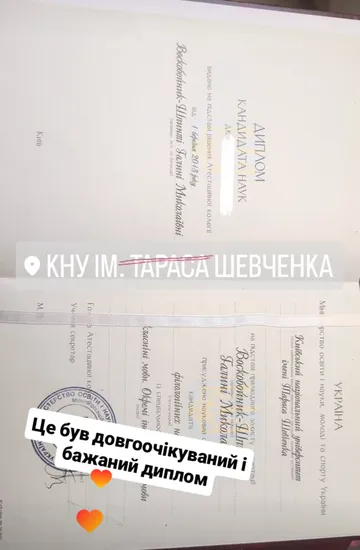
Candidate of Philological Sciences (the Ukrainian equivalent of a PhD) and associate professor (доцент).

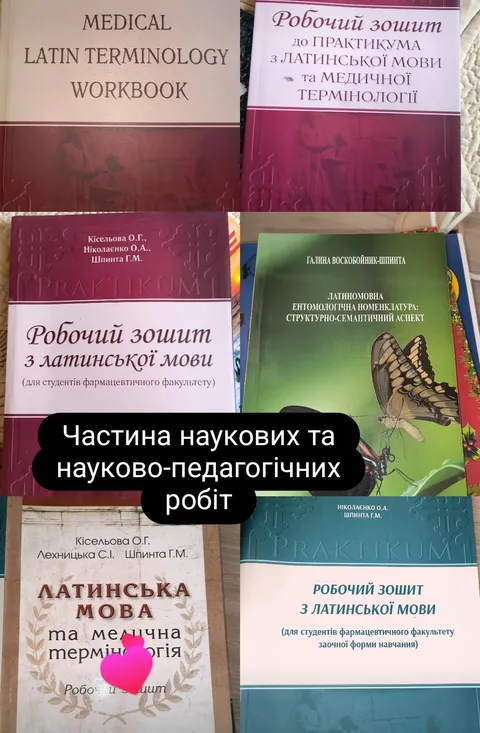
Research and teaching publications
Some of the works I wrote or co-wrote. The full list is on my Google Scholar profile.
- Medical Latin Terminology Workbook
- Латиномовна ентомологічна номенклатура: структурно-семантичний аспект
- Робочий зошит до практикума з латинської мови та медичної термінології
- Латинська мова та медична термінологія. Робочий зошит
- Робочий зошит з латинської мови (для студентів фармацевтичного факультету)
- Робочий зошит з латинської мови (для студентів фармацевтичного факультету заочної форми навчання)
Let’s start with a trial lesson
We’ll find exactly where your gaps are and outline what can be fixed, and how soon.